Guest mode: you can read and try the quiz, but your answers will not be recorded.
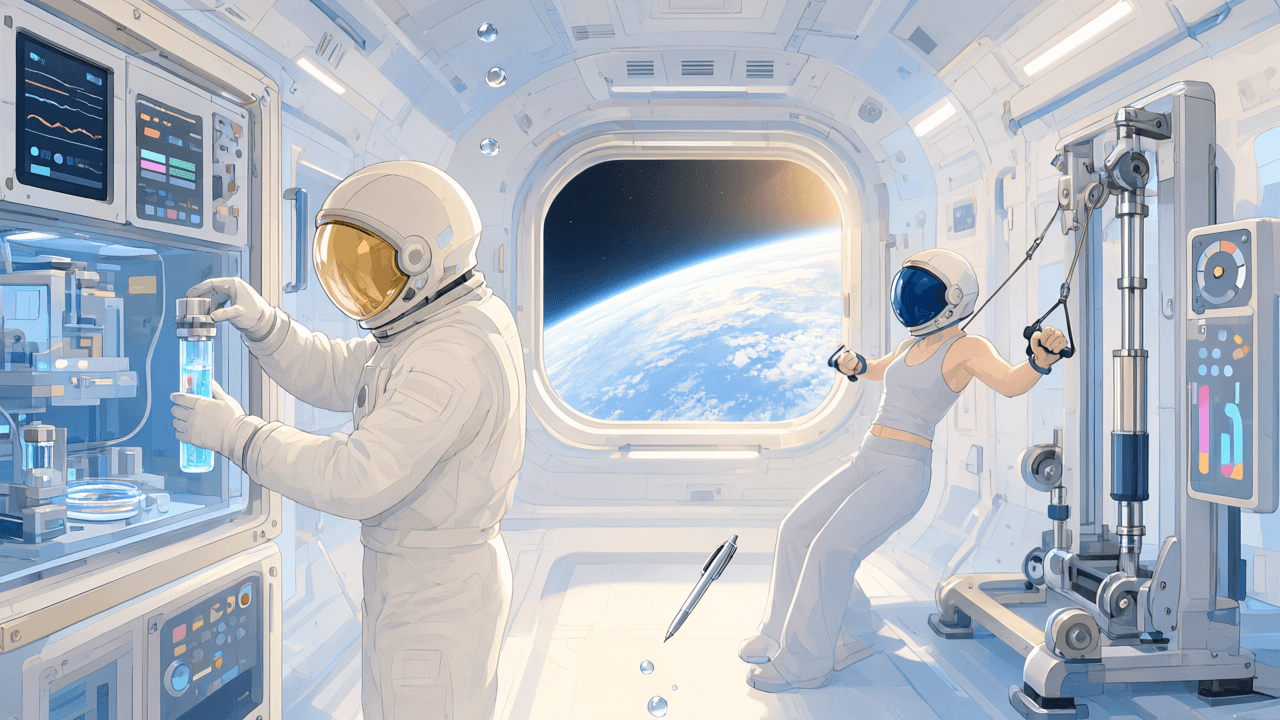
Have you ever wondered whether astronauts just float around and look at Earth all day? In fact they follow a work schedule: running experiments, doing training, checking equipment, cleaning — and exercising every day. Why does exercise become part of the job in space?
According to the China Manned Space Agency, the Shenzhou-23 crew carried out their planned work in orbit. They replaced and processed experiment samples in the high-temperature materials experiment cabinet, and used a metacognition training system to do image-recognition training under different starting conditions — one kind of rendezvous and docking training. They also routinely checked and maintained the regenerative life-support system, counted medicines, organised supplies and cleaned the station.
In microgravity, the body no longer works against gravity the way it does on the ground, so the load on muscles and bones changes, leading to weightlessness-related physiological effects. The report says the three astronauts used devices such as a bone-loss countermeasure instrument and a neuromuscular electrical stimulator to counter these effects. Note carefully: this only says they *use* these devices to counter the effects — it does not mean they have been proven to fully prevent bone loss.
The report also states that experiments in microgravity physical science and other fields in the National Space Laboratory are progressing steadily. This shows that science experiments, professional training and platform care on China's space station are continuing as a routine operation — the station is not just a place to live, but a long-term research and training platform.
This material is a work-progress report. It gives no experimental data, no sample types and no training results. So "experiments progressing steadily" only means the work is going ahead as planned — it is not the same as having scientific conclusions, and the actual effectiveness of countering weightlessness effects still needs more information.
Microgravity: when a space station orbits Earth, the people and objects inside are still pulled by Earth's gravity, but because everything falls freely together, they no longer press against each other — it feels like there is no weight. In this environment, muscles and bones lose their usual load, and the body gradually changes. Countermeasures: if the problem comes from "less load", one approach is to actively add load back to the body, for example using devices that help muscles contract or that apply resistance. This targets the cause, but whether it works needs data to confirm.
"Using a bone-loss countermeasure instrument" does not mean bone loss is fully prevented; the report only says it is used to counter weightlessness effects.
The regenerative life-support system on a space station needs regular checks by astronauts — much like maintaining the plumbing and power at home.
The China Manned Space Agency reported that the Shenzhou-23 crew are on duty aboard China's space station and that work is progressing steadily. Experiments in microgravity physical science and other fields in the National Space Laboratory are advancing steadily; the crew completed sample replacement and processing in the high-temperature materials experiment cabinet, carried out image-recognition training in orbit using a metacognition training system, and routinely checked and maintained the regenerative life-support system.
This article was researched and written from the following materials:
Primary research: 中國載人航天工程辦公室
News report: IT之家11 October 2026Read the original
AI editorial note: this article was rewritten by AI from the materials above and fact-checked. It is not a reproduction of the source article.
This item was auto-summarised and quizzed by AI from whitelisted science news sources. For learning only — use "Report a problem" below if anything looks wrong.