Guest mode: you can read and try the quiz, but your answers will not be recorded.
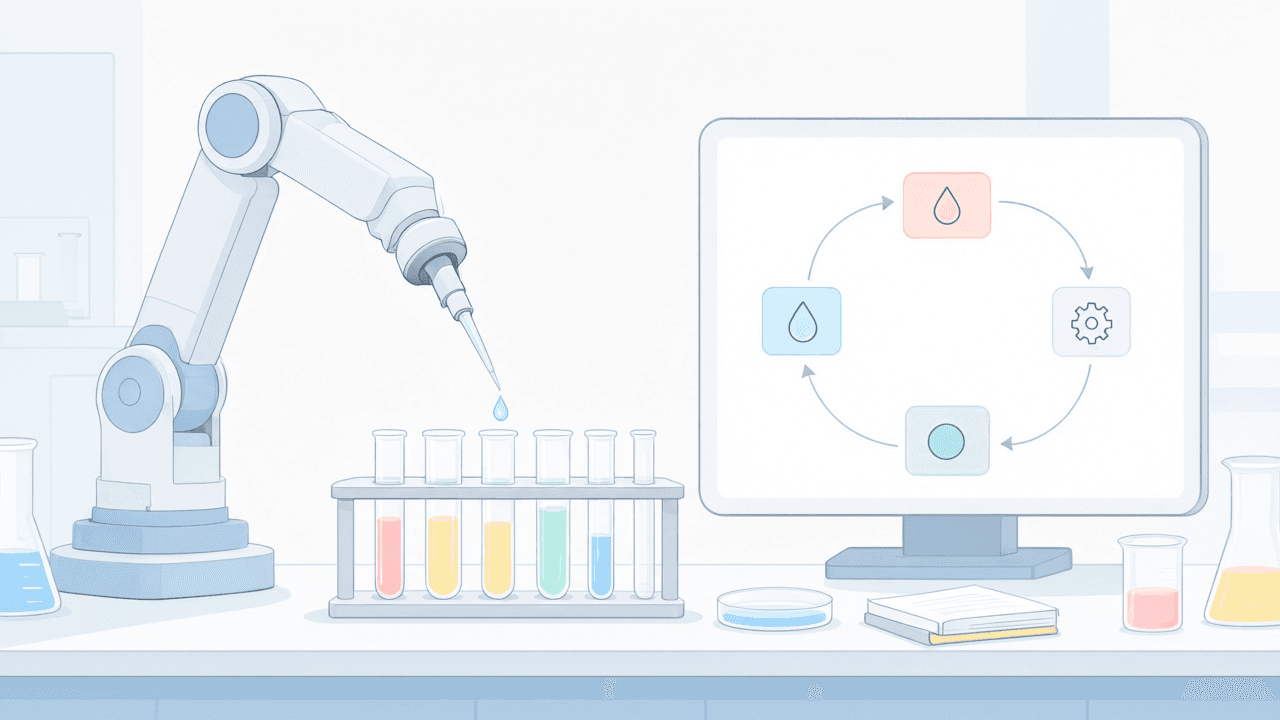
Picture a lab bench: tiny microlitre volumes must be pipetted, positions aligned to the micrometre, and steps carried out in the right order. Done by hand, it is slow and error-prone; yet automated instruments come in different models with incompatible commands. So the question arises: can an AI not only "think" on a computer, but actually carry out experiments?
A team at Shanghai Jiao Tong University built AutoDNA (Siyuan-1), an AI-native science laboratory. They broke complex experiments into steps such as literature search, reagent selection, protocol design, code generation, hardware execution, result analysis and iterative optimisation, handled by several specialised agents working together. They also distilled instrument abilities into "atomic services", described in natural language and offered through a unified interface, so the model can combine equipment and generate and fix cross-device control code.
The key is not just a robotic arm, but that the model links design, experiment and optimisation into one loop, iterating on results. The hardware offers micrometre-level positioning and microlitre-level liquid handling, and the platform includes a control terminal based on the OpenHarmony operating system. In short, the AI's plans can reach real instruments through a unified interface, and results flow back to the model.
The work demonstrated application validation in scenarios such as nucleic acid testing, enzymatic DNA synthesis and cancer detection, and AutoDNA autonomously completed the end-to-end DNA storage pipeline of encoding, writing, storage, reading and decoding. This shows autonomous experiments can cover complex biomolecular scenarios needing micrometre positioning and microlitre handling. Note: the material says "application validation", not that it is already in clinical or routine use.
The material does not report specific results or accuracy in those scenarios, nor quantitative comparisons with manual experiments or existing AI labs. So completing a workflow autonomously does not mean it can fully replace human scientists — only its abilities in particular steps and scenarios are described.
"AI-native" means the system is designed around the model from the start, rather than building instruments first and adding AI on top. The other idea is "atomic services": each instrument's abilities are packaged as a standard unit, so the model can call it without worrying about model differences. Together, these let a model combine equipment and complete multi-step experiments.
"Application validation" means demonstrations in these scenarios, not that it is already used in clinics or routine testing.
The work was published in Nature and featured as a headline story on the journal's homepage.
AutoDNA was built by teams from Shanghai Jiao Tong University's School of Computer Science with the School of Chemistry and Chemical Engineering and the Center for Transformative Molecular Frontiers, based at the Zhangjiang Institute for Advanced Study's DNA Storage Research Center. The platform includes a control terminal based on the OpenHarmony operating system, and the work was published in Nature with a homepage headline feature.
This article was researched and written from the following materials:
Primary research: NatureOpen link
News report: IT之家8 November 2026Read the original
AI editorial note: this article was rewritten by AI from the materials above and fact-checked. It is not a reproduction of the source article.
This item was auto-summarised and quizzed by AI from whitelisted science news sources. For learning only — use "Report a problem" below if anything looks wrong.